Education Structure
The first year
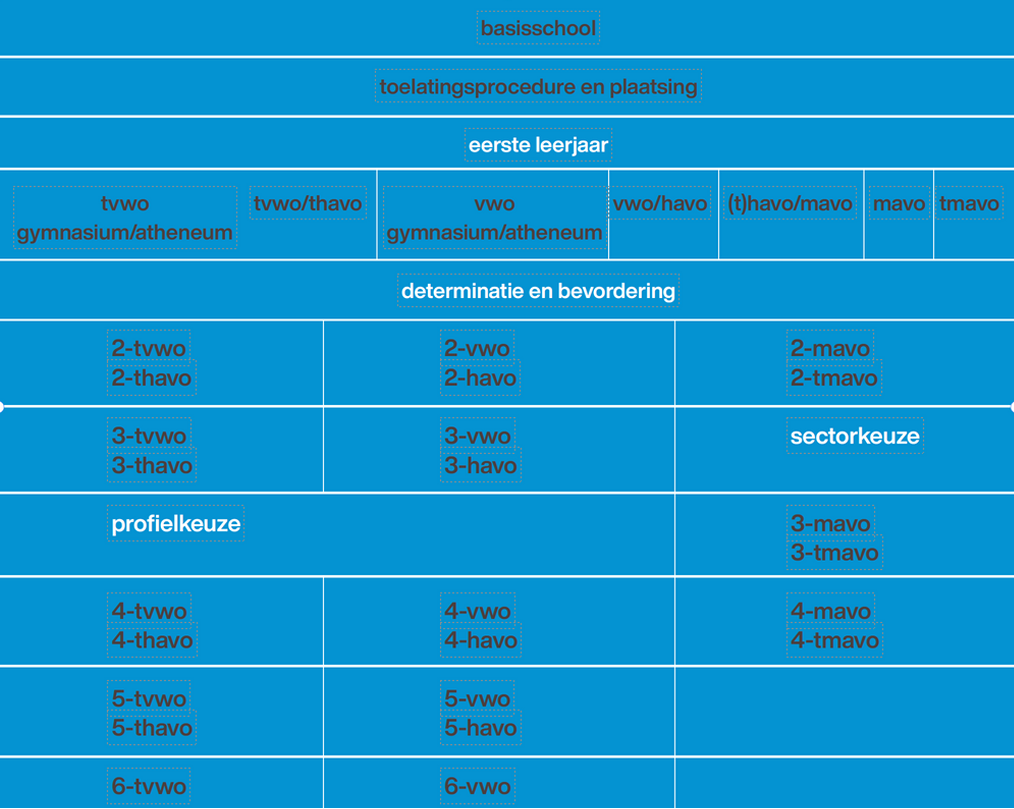
In the first year, we work with mixed classes. Students follow the curriculum of the highest level. This means that pupils in a combined (t)vwo/(t)havo class follow the curriculum for (t)vwo. Pupils in the combined (t)havo/mavo class follow the educational programme for (t)havo.
Pupils in the (t)mavo class follow the four-year mavo programme. If pupils perform well, they can move on (at an intermediate stage) to the next year of a higher level. We believe it is important that after primary school a pupil has sufficient opportunities to develop towards the most suitable level of education.
Once your child has completed the first year, he or she continues with the second year of (t)gymnasium, (t)atheneum, (t)havo or (t)mavo. For most pupils, they continue to follow the school type once they have chosen. Of course, there may be circumstances that make a transfer to another school type necessary. For instance, if your child performs better or worse than expected. In that case, in most cases you will not have to look for another school, but your child will only have to change school type. For the vmbobasis and vmbokader programmes, pupils within our Foundation can attend the Oude Bossche Baan location.
The junior grades
By ‘substructure’ we mean the first two years of (t)mavo and the first three years of (t)havo and (t)vwo. In these years, we want to prepare our pupils well for the superstructure. In doing so, we anticipate the differences between pupils; after all, some develop faster than others.
Your child can make choices in his or her learning process and becomes responsible for their own learning results. Of course, the level of subject matter is monitored so that pupils are offered a continuous learning line.
The curriculum therefore presents the subject matter in context. To link up with the pupils’ world of experience, we work a lot with projects, both subject-oriented and interdisciplinary.
Our education is based on six student competences.
The number of hours worked on each subject per year is listed in the lesson plans in chapter 8. These also indicate the ‘plus hours’ and ‘coach hours’.
Plus hours are hours a pupil spends on individual subject coaching or social-emotional coaching. Coach hours are lessons in which pupils are prepared for the learning and selection process.
Upper secondary (t)mavo
The mavo course consists of theory subjects and more practical subjects such as drawing, music, drama and physical education 2, in which examinations can also be taken.
The examination programme (Programma van Toetsing en Afsluiting, PTA) starts in the third year and ends in the fourth year.
Our mavo programme prepares your child for further education at MBO level and for an independent life in our society. Our examination programme is therefore not only about acquiring knowledge, but also about teaching your child skills through practical assignments, projects, the profile paper and an work placement.
We work with profiles to ensure good progression to further education. At the end of the second year, pupils choose the profiles Technique, Care & Welfare or Economics.
Mavo exams
The mavo exam starts in the third year. Your child will be given one or more tests from the PTA for each subject. Together with these tests in the fourth year, this results in one mark for the school exam. The average of the school exam and the central exam determines the final grade.
Two subjects are completed at the end of the third year: art subjects 1 and social studies. The grade for social studies counts as the seventh or eighth examination subject. The grade for art subjects 1 must be satisfactory or good. If the grade is insufficient, your child cannot obtain a diploma. The latter also applies to physical education in both the third and fourth years. The assessment must be at least satisfactory.
In the third year, a practical work placement assignment is made for which a mark is given. In the fourth year, a profile paper is made, which must be assessed with a satisfactory or good grade. If the assessment is unsatisfactory, your child cannot obtain a diploma.
All tests to be taken from the PTA, the practical assignments and the profile paper are listed in the PTA. The PTA is published before 1 October.
Upper secondary (t)vwo/(t)havo
Profiles
The subject package consists of a common part, a profile part and a free part. The subjects in the common section are compulsory for all pupils. To this part, we have added the subject career orientation. This subject is also compulsory.
In the profile section, your child can choose from the following four fixed subject packages:
- Culture and Society;
- Economy and Society;
- Nature and Health;
- Nature and Engineering.
In the free part, your child must choose a subject from a number of new subjects or from the subjects of another profile. If your child wants to take more than one subject for the free part, this will be included as a ‘crammer subject’. This ‘sprokkelvak’ can usually also be examined, but it does not count in a student’s failure or success. However, if the result is satisfactory, the additional subject can be substituted for another subject, provided it fits the chosen profile.